Why Fall Is the Best Time for Pool Filter Cleaning in Orange County
If you only deep-clean your pool filter once a year, do it in early fall. That is the honest answer, and here is the short version of why: your filter just absorbed the heaviest bather load, sunscreen, and debris of the entire year, and the windiest, dirtiest season in Orange County is about to start. Scheduling pool filter cleaning in Orange County between September and early October means your filter enters Santa Ana wind season with full capacity instead of half of it.
At Dream Pools, we service pools across Orange, Villa Park, Anaheim Hills, Tustin, and the surrounding communities every week, and fall is when we see the difference between filters that were cleaned and filters that were forgotten. The forgotten ones show up in November as cloudy water, climbing pressure gauges, and pumps working overtime. This post explains what summer actually does to your filter, why the fall timing matters more here than almost anywhere else, and how to tell whether yours is due right now.
The Short Answer: Clean Your Filter in Early Fall
A pool filter in Orange County should get a full professional cleaning at least once a year, and early fall is the best time to do it. Summer swimming loads the filter with sunscreen oils, body oils, and fine debris, while the Santa Ana winds that arrive between September and January dump dust, grit, and ash into local pools faster than any other season. Cleaning the filter in September or October restores full filtration capacity right before it is needed most.
If your pool sees heavy use, sits under trees, or runs a spa and water features, twice a year is the better rhythm: once in spring before swim season, and once in early fall before wind season.
What a Summer of Swimming Actually Does to Your Filter
Your filter does not just catch leaves. Over a full Orange County summer, it accumulates a specific mix of contaminants that a quick rinse cannot remove.
Sunscreen and body oils are the big one. Every swimmer deposits oils into the water, and those oils bind to cartridge pleats and DE grids as a greasy film. A garden hose will knock loose dirt off a cartridge, but it will not cut through months of oil buildup. That takes a proper degreasing soak, which is part of a professional cleaning and almost never part of a DIY rinse.
Then there is the chemistry side. Hard Orange County water leaves calcium scale inside filter media the same way it scales your tile line. Combine mineral scaling with oil film and fine dust, and by Labor Day the effective surface area of your filter can be a fraction of what it was in May. Your pressure gauge tells the story: when the reading sits 8 to 10 PSI above your clean baseline, water is fighting to get through, circulation drops, and your pump draws more power to move less water.
Reduced circulation is exactly how algae gets a foothold. Water that is not turning over properly holds warm, still pockets where algae blooms start, which is why a neglected filter in September often becomes a green pool call in October. If your water has already tipped, our green pool recovery service handles that, but a fall filter cleaning is the cheaper way to never make that call.
Santa Ana Wind Season Is About to Test Your Filter
Here is the part that makes fall filter timing an Orange County issue specifically. The Santa Ana winds typically kick off in September and run through January, funneling hot, dry air out of the inland deserts and through the canyons. If you live in Anaheim Hills, North Tustin, Orange Park Acres, or anywhere near the Santa Ana Canyon corridor, you already know what a two-day blow does to a pool: a layer of dust and grit across the surface, full skimmer baskets, and water that hazes over even when the chemistry reads fine.
All of that windborne material ends up in one place. Your filter.
During fire season, it gets worse. Ash is extremely fine, it carries phosphates that feed algae, and it clogs filter media faster than ordinary dust. A filter that starts wind season already half-loaded from summer has very little capacity left when the first real Santa Ana event hits. A filter that was professionally cleaned in September handles the same event without the pressure spike, the cloudy water, or the emergency service call.
This is the whole logic of fall timing in one sentence: clean the filter after the season that loads it and before the season that tests it.
How to Tell Your Filter Is Overdue Right Now
You do not need to open the tank to know. Watch for these signals:
- Pressure gauge reading 8–10 PSI above your clean baseline. This is the most reliable indicator across every filter type. If you never recorded a baseline, that alone suggests the filter has not had proper attention.
- Weaker return jet flow. Put your hand in front of a return. If the push feels noticeably softer than it did in June, flow is restricted.
- Water that stays cloudy with balanced chemistry. When chlorine, pH, and alkalinity all test fine but the water will not polish up, filtration is the bottleneck.
- Shorter intervals between backwashes on sand and DE systems, or a pump that sounds like it is straining.
The maintenance rhythm also depends on what you are running. Cartridge filters, common on newer Orange County installs, need their elements pulled, degreased, and soaked rather than just hosed. DE filters need the grids broken down, cleaned, and recharged with fresh diatomaceous earth, since backwashing alone never removes all the spent media. Sand filters backwash routinely, but the sand bed itself channels and hardens over the years; if yours is 5 or more years old and the water is not clearing, the fix is usually a sand change rather than another cleaning.
And one honest caveat from the field: if we open a filter and find cracked cartridge bands, torn DE grids, or a failing multiport valve, cleaning will not solve it. That crosses into pool filter repair territory, and catching it in September beats discovering it during a December wind event.
What a Professional Filter Cleaning Includes
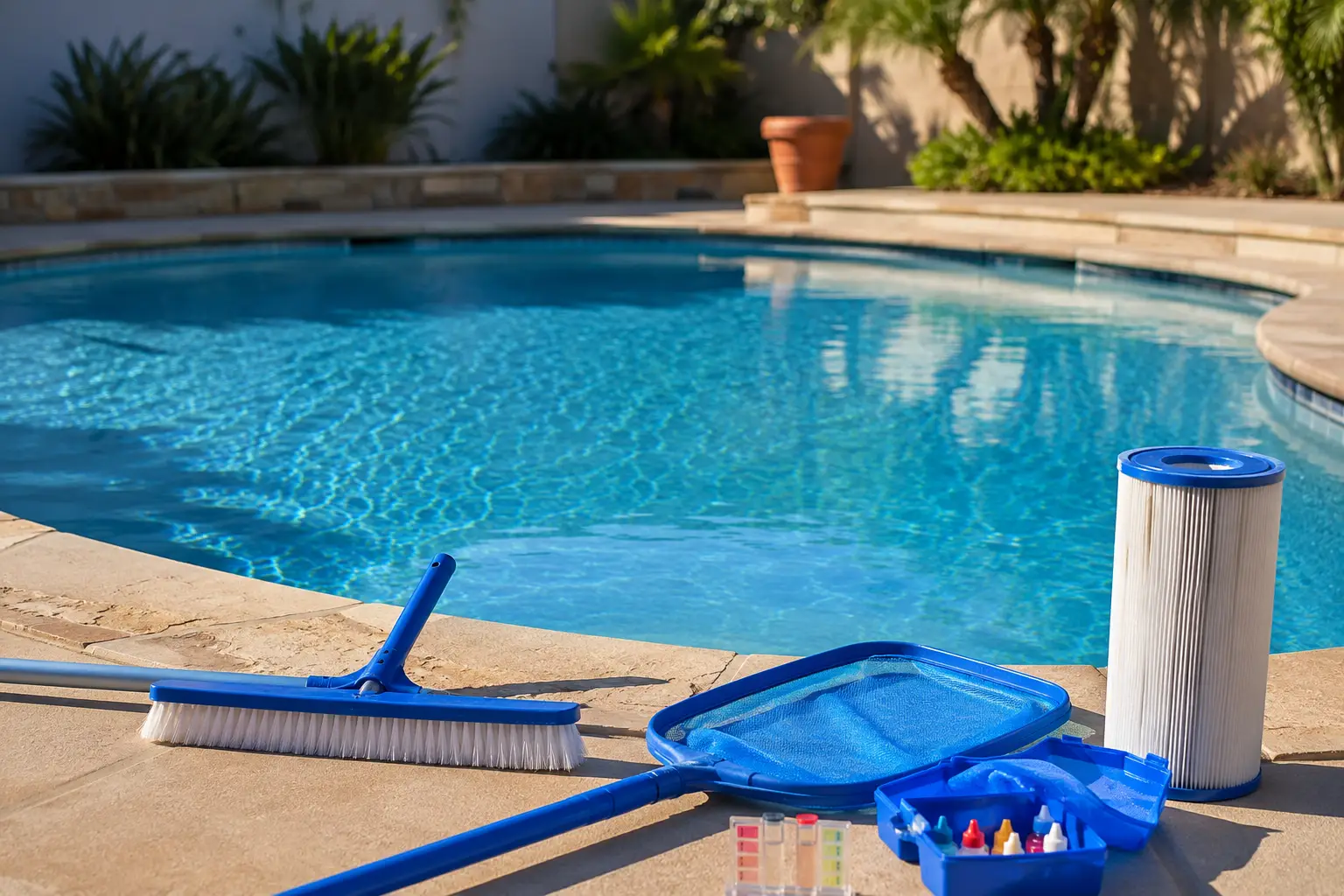
A real filter cleaning is a teardown, not a rinse. When Dream Pools performs a [INTERNAL LINK: filter cleaning → /pool-cleaning/filter-cleaning/], the tank comes apart completely. Cartridge elements or DE grids come out, get inspected under good light for tears, cracks, and worn bands, then get degreased and deep-cleaned to strip the oil and mineral film that a hose leaves behind. O-rings get checked and lubricated, the tank gets flushed, DE systems get recharged with fresh media, and everything gets reassembled and pressure-tested so you have a true clean baseline reading to watch through the winter.
We work on all the major systems in local backyards, including Hayward, Jandy, Pentair, and Zodiac equipment, and our technicians are led by a Certified Pool & Spa Operator with more than a decade on Orange County pools. If you are on our weekly pool service routes, your technician is already tracking your filter pressure on every visit and will flag the cleaning before the gauge forces the issue.
Frequently Asked Questions
How often should a pool filter be cleaned in Orange County?
At minimum once a year, and ideally twice: spring and early fall. Orange County pools run year-round, deal with hard water scaling, and take on heavy debris during Santa Ana wind season, so filters here load faster than the once-a-year national advice assumes. Pools with heavy use, spas, or lots of surrounding trees should stay on the twice-a-year schedule.
What happens if I never clean my pool filter?
Pressure climbs, circulation drops, and the pump works harder while moving less water, which raises your electric bill and shortens pump life. Poor circulation also invites algae blooms and cloudy water even when chemistry is balanced. Eventually the filter media itself fails, turning a routine cleaning into a repair or replacement.
Can I just hose off my cartridge filter myself?
A hose rinse removes loose debris but leaves the sunscreen oils and calcium scale that actually restrict flow. Those require a degreasing soak and, for mineral buildup, an acid-based cleaning done carefully to avoid damaging the pleats. A rinse between professional cleanings helps; it does not replace them.
What pressure reading means my filter needs cleaning?
The standard rule is 8 to 10 PSI above your clean baseline, which is the reading right after a professional cleaning. If you do not know your baseline, have the filter cleaned and record the gauge reading the same day. From then on, the gauge tells you exactly when it is time.
Do Santa Ana winds really affect pool filters that much?
Yes. Santa Ana events push desert dust, fine grit, and during fire season, ash directly into pools across Orange, Anaheim Hills, Tustin, and the canyon-adjacent neighborhoods. Ash is especially hard on filters because the particles are extremely fine and carry phosphates that feed algae. A freshly cleaned filter absorbs a wind event; a loaded one clogs.
How long does a professional filter cleaning take?
Most cartridge and DE filter cleanings take one to two hours on site, depending on the system size and condition. If the elements need extended soaking or we find damaged grids or cartridges, we will tell you before doing any additional work.
Get Your Filter Cleaned Before the Winds Arrive
The math on fall filter cleaning is simple. It costs far less than the green pool recovery, the pump strain, or the emergency call that a clogged filter causes in November. Your filter carried the whole summer; give it a clean start before the Santa Anas put it back to work.
Dream Pools provides professional filter cleaning throughout Orange, Orange Park Acres, Villa Park, Anaheim Hills, Anaheim, North Tustin, Tustin, and Santa Ana.